
Answers
Frequently Asked Questions
Every question people ask before booking a roll-off in Bloomington-Normal, answered the way we would on the phone.
- Licensed & insured
- Same-day in many areas
- Flat-rate pricing
- Bloomington-Normal & McLean County
Everything people ask before they book
If you are renting a dumpster for the first time, you probably have the same dozen questions everyone does: what it costs, what size, whether the City will mind, and what you cannot throw in. Whether you are clearing out a home, remodeling a kitchen, handling a roofing project or managing a construction site in Bloomington-Normal, the answers below are the ones we give on the phone every day. If yours is not here, call (309) 893-1463 — a real person on our local team will answer it.
Part 1
Pricing
How much does a dumpster rental cost in Bloomington, IL?
Prices vary with the dumpster size, the type of debris, the delivery location and the rental duration, so we quote each job rather than publish a price list. We offer flat-rate pricing whenever possible, with delivery, pickup and disposal typically included and no hidden fees. Every quote includes a weight allowance — about 1 to 2 tons on a 10 yard, 2 to 3 on a 15, 3 to 4 on a 20, 4 to 5 on a 30 and 5 to 6 on a 40. Call (309) 893-1463 for a quote. The cost guide explains what moves the number.
Is delivery and pickup included in the price?
Yes. Delivery, pickup and disposal up to the included weight are typically included in your quote, along with the standard rental period. No hidden fees and no surprise charges.
What causes extra charges?
Two things: going over the included weight, when an overage fee may apply based on disposal weight, and keeping the container past the standard rental period, at an additional daily or weekly rate. Extra pickups or swap-outs are part of the quote too. We explain the terms up front so there is nothing to find later.
Do you charge more for heavy materials like concrete or dirt?
Heavy material such as concrete, dirt, brick, asphalt or rock uses up the included weight fast, and it usually goes only in the smaller containers, such as a 10 or 15 yard, because heavy materials have strict weight limits for safe transport. Heavy material mixed with household junk may need special handling or pricing, so we size it differently and tell you where the weight line is before you load.
What payment methods do you accept?
Major credit and debit cards. Payment is generally made when your booking is confirmed, to reserve your delivery slot. Where an independent provider handles the rental, billing may be handled by that provider, and we tell you on the call.
Part 2
Sizing
What size dumpster do I need?
A 10 or 15 for small cleanups, roofing or concrete; a 20 for home remodels and landscaping; a 30 or 40 for construction, demolition or large cleanouts. Count the job in pickup truck loads — about 3 for a 10, 4 to 5 for a 15, 6 for a 20, 9 for a 30 and 12 for a 40. Weight decides for dense material — see the size guide.
What happens if I order too small?
Too small and you may need another pickup; too big and you have paid for space you do not use. When in doubt, describe the job and let us size it. If your project grows, we can swap your dumpster.
What is the biggest dumpster you offer?
A 40 yard: about 22 ft × 7.5 ft × 8 ft, roughly 12 pickup loads, usually about 5–6 tons included. It is the largest size we offer.
How full can I fill it?
Keep all debris below the top rim. If it is overfilled, it may not be legal or safe to haul. Even weight distribution also helps ensure a smooth pickup.
Can I rent a dumpster for a roofing job?
Absolutely. Our 10 and 20 yard dumpsters are popular for roofing shingles, tar paper and underlayment, and shingles are heavy, so tell us the roofing squares and we will recommend the box around the weight. Roofing shingles count as general construction debris under Illinois law, not a banned material.
Part 3
Permits, placement and town rules
Do I need a permit to have a dumpster delivered?
If the dumpster will sit on private property such as your driveway, we found no Bloomington permit rule for it, and no City time limit or surface rule. A street is different. A dumpster, moving container or anything similar in the City right-of-way or street needs a Dumpster Permit from the City Engineering Division, submitted at least 72 hours before delivery — we say allow at least 3 business days. Under the permit, the container sits in a legal parking space in front of the property using it, with Type I or Type II lighted barricades at the front and rear at all times; it is covered whenever it is not actively in use; and the permit runs no more than 30 days unless the Director of Engineering approves longer. In an alley, the permit holder contacts nearby residents and businesses to arrange their access. The Engineering page lists no fee for the Dumpster Permit, so ask Engineering when you apply. Separately, City Code requires a street closure permit before anyone obstructs a sidewalk, parkway, alley or parking lane (§ 38-303). The permit guide and your town page cover the details.
Can the dumpster go on the street if my driveway won't fit it?
In Bloomington, only with the Engineering Division's Dumpster Permit, as above. In Normal, Town code says roll-off boxes are not permitted in a front yard or on a dedicated street right-of-way unless the Director of Public Works gives temporary permission for the right-of-way (§ 21.1-4); the Town's Dumpster/Storage Container Permit goes through the Engineering Department (309-454-9578), may require a lighted barricade, and allows work only in daylight hours. Elsewhere: Hudson and Le Roy require the Mayor's written permission before building materials go in a street (Hudson 7-1-3, Le Roy § 7-1-2); Lexington needs the Street Superintendent's authorization (§ 190-5); and Lincoln bars a dumpster over two cubic yards from a street without a Street Department permit, a bond and reflective striping (Ch. 8-3). Tell us when you book and we plan the placement around it.
Is my street a city street or a state route?
Not always obvious. Veterans Parkway (I-55 Business), I-55, I-74, US-150 and IL-9 are state routes, and parts of Main Street, Center Street and Market Street in Bloomington carry US-51 Business and US-150, where some segments are state-maintained. IDOT requires a permit for work in a state route's right-of-way and has no permit type for a container, so there the box stays on private property. The street our yard is on is a city street. If you are not sure, tell us the address and we will check which rules apply.
Why do some of your town pages mention hauler licences?
Because some cities license the companies that haul waste. Bloomington's City Code Chapter 36 requires a City licence to collect, transport or dispose of waste for profit, and names construction or demolition work and dumpsters among its examples; the licence expires each April 30. Lincoln requires a City waste hauler licence that covers construction dumpster services (Ch. 3-21). Heyworth requires Village Board authorization to collect garbage (Code 9-5-3C), and Normal regulates private refuse collectors (§ 21.1-5). We found no county hauler licence in McLean County. Each town page states its rule.
Does my HOA matter?
It can. HOA rules can cover containers on your driveway, and we do not know your HOA's rules — check them before you book.
Will the dumpster damage my driveway?
We take precautions to protect your property. If you are concerned, you can place plywood or boards under the wheels for added protection, and we can discuss protective boards when you book. Keep it off soft ground and grass.
How much space does the truck need?
A flat, solid surface such as a driveway, gravel or pavement; room for the container — about 14 feet long for a 10 yard, 16 feet for a 15, and about 22 feet for a 20 and up, all about 7.5 feet wide; about 60 feet of clear approach for the roll-off truck, more if it has to turn; and clear space overhead. Branches, utility lines, parked cars, bins and equipment are the usual problems.
Part 4
Booking and delivery
How do I book a dumpster?
Call (309) 893-1463. Tell us about your project — the address, what is going in and roughly how much — and we recommend the right dumpster, quote it and schedule delivery on the same call.
How fast can you deliver?
Same-day or next-day when availability allows, in many areas around Bloomington and the nearby communities. For the best chance of same-day, call early in the day — before midday is best.
What are your hours?
The phone is answered 24 hours a day, 7 days a week. Deliveries and pickups go into working windows — we do not promise night or Sunday drop-offs — and in Normal, Town code limits private collection at one- and two-family homes to 6 a.m. to 6 p.m., Monday through Saturday (§ 21.1-5).
How long can I keep the dumpster?
Standard rentals are commonly 3 to 7 days, and we can often extend your time for an additional daily or weekly fee, depending on availability. If you finish early, call and we will schedule an early pickup. Some rules set their own limits: a Bloomington street Dumpster Permit runs up to 30 days unless the Director of Engineering approves longer, and in Normal a hauler's dumpster may not stay on a customer's property more than six days after service ends (§ 21.1-5).
Do I need to be home for delivery or pickup?
No. As long as we know where to place the dumpster — a driveway or a job site — you do not need to be there. Please make sure the area is clear of vehicles and obstacles.
Can I book multiple dumpsters at once?
Yes. Several dumpsters at once, staggered deliveries and scheduled rotations are routine for contractors and property managers.
Part 5
Service area
What towns do you serve?
Bloomington, Normal, Towanda, Downs, Hudson and Heyworth; Le Roy, Lexington, Danvers, Gridley, Chenoa and El Paso; and Clinton, Lincoln and Pontiac — each with its own page. The complete Bloomington guide pulls it together.
Where are you based?
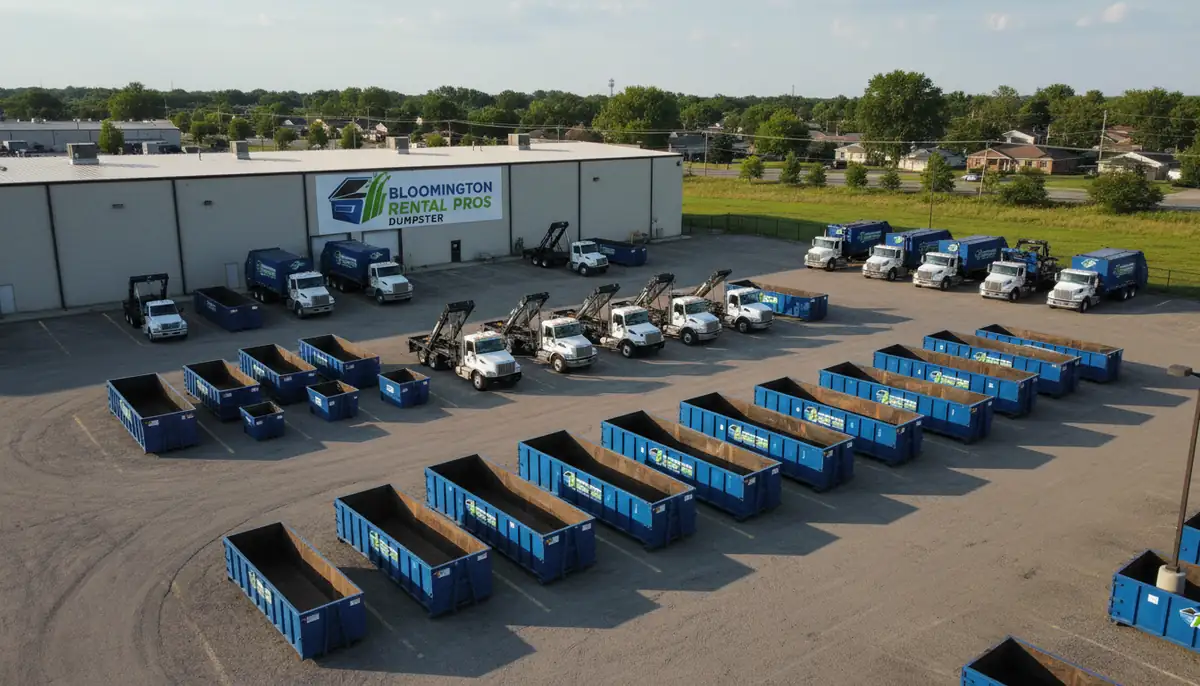
At 2014 Cabinton Rd, Bloomington, IL 61701 — inside the City of Bloomington, McLean County, on a city street right by the I-55 / I-74 and Veterans Parkway interchange on the south-west side of town.
Is service different in the far towns?
Mostly the timing. Pontiac, our furthest stop, is about 43 road miles from the yard, and Chenoa about 32. Price depends partly on the delivery location, and we say any difference up front.
Are Bloomington and Normal the same place?
No — they are twin cities with separate governments and separate rules. Bloomington is a city of 78,680 people and Normal a town of 52,736 (2020 Census), both in McLean County. A street placement in Bloomington goes through the City's Engineering Division; in Normal, through the Town's Engineering Department. The rules follow the city the property is in, not the mailing address.
Do some places restrict who can deliver a roll-off?
A few. Lincoln has an exclusive residential franchise for single-family homes through February 28, 2027; its agreement excludes construction waste, and the City requires a waste hauler licence that covers construction dumpster services. Heyworth requires Village Board authorization to collect garbage, and Downs requires every occupied home and business to use Village refuse collection — in those three, we check the local rules before booking. Illinois law bars cities under 1,000,000 people from awarding a franchise for construction or demolition debris collection (65 ILCS 5/11-19-1(f)). Each town page says what that town asks for.
Part 6
What we take
What can I put in a dumpster?
Most household junk, construction debris and yard waste: wood, drywall, tile and flooring, furniture and household junk, mattresses, roofing shingles, small appliances and remodeling debris — plus concrete, brick, dirt, asphalt and rock within the weight limit, in a 10 or 15. Yard clippings and branches go in their own load.
What can't go in a dumpster?
Paint, solvents and oils, tires, batteries, hazardous chemicals, gas cylinders and propane tanks, medical waste and asbestos stay out, and so do appliances still holding refrigerant. Illinois also keeps electronics such as TVs, computers, monitors and printers (415 ILCS 151/1-83), lead-acid vehicle batteries (415 ILCS 5/22.23), used tires (415 ILCS 5/55), white goods with their regulated components still in (415 ILCS 5/22.28), landscape waste mixed with other waste (415 ILCS 5/22.22) and liquid used oil (415 ILCS 5/21.6) out of landfills. If you are unsure about an item, call before loading it. The what can and cannot go in guide says where each of those goes instead.
Can asbestos-containing material go in a dumpster?
No. The Illinois EPA enforces the federal asbestos rules for demolition and renovation, and a regulated job needs a notification filed 10 working days before work starts; privately owned homes and apartment buildings with four or fewer units are exempt unless they have had, or will have, a commercial or public use. Illinois' definition of construction debris includes only non-asbestos insulation, and asbestos waste goes containerized and labelled to an approved landfill — never in a roll-off.
Can I put concrete, brick or dirt in a regular dumpster?
Yes, but usually only in smaller dumpsters such as a 10 or 15 yard, because heavy materials have strict weight limits for safe transport. Clean broken concrete, brick, rock and asphalt is clean construction or demolition debris under Illinois law (415 ILCS 5/3.160), so a clean load of it is easier to recycle than a mixed one.
Can I put a mattress or an old appliance in?
Mattresses, yes — they are not on the Illinois landfill ban list. Small appliances, usually yes. Fridges, freezers, air conditioners, water heaters, ranges and humidifiers are white goods, which Illinois will not let go for landfilling unless the refrigerant, mercury switches and other regulated components have been removed (415 ILCS 5/22.28), so unless they have been properly prepared they stay out. Our junk removal crew can take appliances, with the Freon removed when required, and Bloomington residents can take them to the City's Citizen Convenience Center.
What happens to the debris after pickup?
It goes to a permitted facility for that kind of waste. There is no active municipal solid waste landfill in McLean County — the Illinois EPA lists the county's landfills as closed — so loads travel to permitted facilities outside the county. Mixed construction debris can go to a construction and demolition recovery facility, which has to show that at least 40 percent of what it takes in is recyclable (415 ILCS 5/22.38), and we work with local disposal and recycling facilities to divert metal, concrete and yard waste from landfills whenever they are accepted.
Guides that go deeper
Ready when you are
Question not answered here?
Call (309) 893-1463. A real person on our local team will answer it and, if you like, book the container on the same call.
(309) 893-1463Open 24 hours, 7 days